

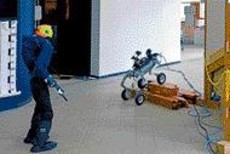
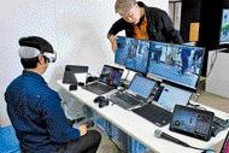
Japan’s Building Research Institute conducted a public demonstration on March 10, showcasing a disaster-response system that utilizes autonomous artificial intelligence to coordinate bipedal and quadrupedal robots. The trial, held at BRI’s facilities in Tsukuba, Ibaraki Prefecture, simulated a post-disaster building inspection where robots approached structural elements such as columns and walls to assess tilt and damage levels.This initiative marks an initial step toward realizing "Physical AI"—a framework where AI autonomously controls the physical movements and decision-making of robotic hardware. While the current system still requires significant human intervention, BRI plans to progressively increase the proportion of tasks AI can handle independently. Developed in partnership with Tokyo-based Pocket Queries, the system utilizes commercially available robot hardware paired with proprietary software. Operators use Mixed Reality (MR) to monitor and manage the robots. Instructions are relayed to the AI via voice commands. The AI manages both the physical locomotion of the robots and the visual analysis required for damage assessment. The system can automatically generate inspection reports based on images captured by the robots' cameras.At the present stage, the quadrupedal robot’s autonomous capability is limited to tracking the bipedal unit. Complex maneuvers, such as entering buildings or navigating close to walls, are still manually directed by human operators. Furthermore, the robots currently lack advanced manipulation skills, such as the ability to grip objects. Despite these limitations, BRI researchers emphasize the rapid evolution of the field. "Our ultimate goal is a system where a human provides high-level instructions, and the robot independently evaluates the situation using its sensors to act autonomously," said Senior Researcher at BRI. The long-term vision involves a "leader-follower" model where one bipedal robot commands multiple quadrupedal units to conduct autonomous surveys of disaster-stricken homes. Beyond emergency response, BRI intends to adapt this technology for routine building maintenance and infrastructure management during peacetime. (2026/03/12)