

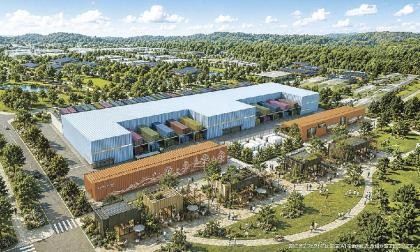
NTT Facilities, Inc. announced on July 1 that it has begun developing a new construction method designed to drastically shorten the time required for regulatory filings, design, and construction of data centers. The company has reached a basic agreement with Nippon Steel Engineering Co., Ltd. to collaborate on standardizing modular data centers utilizing system building techniques. By developing a model in which factory-manufactured components are assembled on-site, the companies aim to reduce the total period required for application, design, and construction of large-scale DCs by up to approximately 50% compared with conventional methods.This initiative represents the third installment of NTT Facilities’ next-generation DC project. The standardized DC model, named "Hyper Ready Module," accelerates construction timelines by modularizing five primary structural components—foundations, retaining walls, structural steel frames, exterior walls, and roofs—and prefabricating them in factories. Additionally, major HVAC (heating, ventilation, and air conditioning) and power equipment will be installed outdoors, allowing for a low-rise (typically one- to two-story), lightweight building structure.The structural engineering adopts a hybrid vibration-damping and base-isolation system. While the building structure itself features high seismic resistance, key equipment is fitted with vibration control systems, and the data hall floors housing IT servers feature floor-level base isolation. By maintaining Business Continuity Plan (BCP) performance equivalent to that of a fully base-isolated building without making the entire structure base-isolated, the framework eliminates or streamlines lengthy administrative processes, such as structural evaluations and ministerial approvals, as well as the time needed for foundation and base-isolation work.Building equipment and services are similarly modularized. Beyond the primary framework, equipment-supporting sub-frames designed to hold piping and electrical wiring are pre-constructed. Air conditioning pipes and electrical cabling are assembled into units in factory settings prior to site delivery, minimizing high-elevation work requiring aerial lifts and enhancing operational efficiency.By standardizing every phase from initial design to final assembly, the project targets a streamlined schedule of one year for applications and design, and one year for construction on hyperscale facilities (ranging from tens to hundreds of megawatts). This reduces the overall project timeline to approximately two years.NTT Facilities plans to refine the specifics in collaboration with data center operators and relevant regulatory authorities, targeting commercial deployment in fiscal 2028. (2026/07/02)