

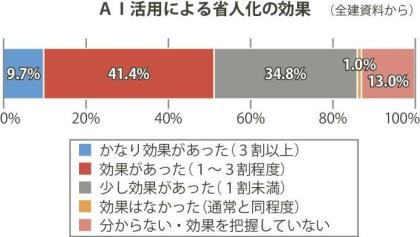
The adoption of artificial intelligence in Japan’s construction sector is steadily expanding. A survey conducted by National General Contractors Association of Japan revealed that 18.7% of its member companies have already integrated AI technologies into their office and construction site operations.The application of AI is heavily concentrated in back-office administrative tasks, with 89.3% of active AI users deploying conversational generative AI services for document preparation, meeting minutes, and translation.Regarding the tangible impact of these technologies, approximately 50% of the companies adopting AI reported achieving a labor reduction effect of 10% or more. Respondents highlighted significant productivity gains, with one firm noting, "By alleviating administrative burdens on site engineers, such as document preparation, engineers can dedicate more time to on-site management, leading directly to higher efficiency."The survey, which focused on productivity enhancement initiatives for fiscal year 2025, gathered responses from 2,750 member companies. Among companies utilizing AI, 9.7% reported labor savings of "30% or more," while 41.4% achieved reductions of "10% to 30%." On the other hand, although 81.3% of respondents have not yet implemented AI, 62.6% of those non-users expressed strong interest in adopting the technology, signaling strong potential for wider future adoption.Among firms interested in future implementation, administrative and back-office operations—including AI-assisted drafting, minute-taking, and translation—ranked highest at 69.9%. On-site safety management (such as AI-driven hazard detection cameras and machinery collision avoidance systems) followed at 61.0%, while schedule and management planning (optimizing timelines and personnel allocation based on data analysis) stood at 41.5%.Despite the optimism, industry representatives cautioned that technology alone cannot fully solve systemic workforce shortages. "While AI and digital transformation (DX) offer clear productivity gains, they cannot single-handedly solve the fundamental burdens on the ground," noted one member company.Alongside technological adoption, industry voices called for structural reforms, including document simplification and the relaxation of regulations governing concurrent management duties across multiple job sites. "Establishing an environment where a single engineer can manage multiple projects without undue strain is absolutely essential," emphasized another respondent. (2026/07/07)