

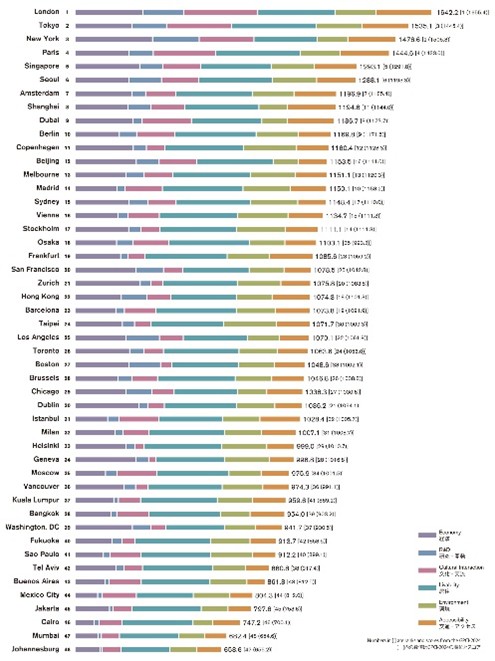
The Mori Memorial Foundation’s Institute for Urban Strategies on December 17th released the results of its Global Power City Index 2025. Covering 48 major cities worldwide, the ranking saw London retain the top position, while Tokyo climbed to second place for the first time, overtaking New York. Although Tokyo lost ground in several economic indicators, it improved its overall score primarily in the cultural interaction and livability categories. Osaka surged to 18th place from 35th in the previous ranking, while Fukuoka rose to 40th from 42nd.At a briefing held in Tokyo the same day, Director of the think tank Heizo Takenaka noted that “changes in the environment, including post-COVID trends and policies in various countries, are vividly reflected in this year’s urban rankings.” Hiroo Ichikawa, a board member of the foundation, commented on Tokyo’s rise, saying, “New York, which was ranked second last year, dropped in position, resulting in a relative increase in Tokyo’s score.”The ranking evaluates cities’ overall competitiveness across six categories: economy; research and development; cultural interaction; livability; environment; and transportation and accessibility. Each category is broken down into detailed indicators, with scores assigned to a total of 72 indicators. Cities are ranked based on their aggregate scores.The top five cities were London, Tokyo, New York, Paris, and Singapore, in that order. A closer look at Tokyo’s indicators shows that while its score for “gross domestic product (GDP) growth rate” improved in the economic category, scores declined for indicators such as “Global Top 500 Companies,” “GDP,” and “workplace attractiveness,” highlighting weaknesses in the city’s business environment.In the cultural interaction category, Tokyo improved its scores in three indicators—tourism resources, nightlife attractiveness, and number of foreign visitors—earning top-tier evaluations and solidifying this area as one of its core strengths.Regarding Osaka’s sharp rise, Ichikawa pointed out that the city attracts more foreign visitors than Tokyo. “Hosting the Expo brought people and capital together, giving the city strong momentum. It should continue to perform well next year,” he said.During the briefing, questions were raised about the outlook for residential property prices in Tokyo and issues related to urban development. Ichikawa noted that Japanese real estate prices remain lower than those overseas, explaining that “housing prices in Tokyo’s central five wards are likely to continue rising until they reach global standards.” On the impact of rising construction material costs and labor shortages on urban development, he observed, “Redevelopment projects are now being more selectively pursued. Construction will proceed in areas with strong demand, while projects in weaker areas will stall.”Takenaka cited Japan’s National Strategic Special Zones as an example, stating that “comprehensive deregulation is significantly enhancing the attractiveness of central urban areas.” (2025/12/18)