

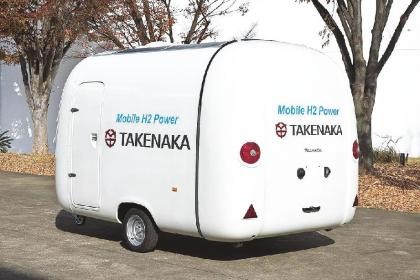
Takenaka Corp. and Partners Develop Towable Hydrogen Power Generator Japanese construction company Takenaka Corporation, in collaboration with Nasu Denki-Tekko Co., Ltd. and Nippon Filcon Co., Ltd., has developed a towable hydrogen power generation system. The mobile power source, which mounts hydrogen tanks and fuel cells on a trailer, generates electricity using hydrogen fuel, resulting in near-zero carbon dioxide (CO2) emissions. Integrating hydrogen power, solar generation, and storage batteries, the stable energy system provides approximately 20 kilowatt-hours (kWh) of electricity—equivalent to two days of average household consumption—immediately upon installation. Continuous power supply is possible through the replacement of hydrogen tanks. The companies are currently conducting demonstrations, including trials for construction power at Takenaka’s own project sites.The hydrogen storage system features metal hydride tanks developed by Takenaka and Nasu Denki-Tekko. These compact, lightweight tanks allow for the safe and easy storage and transport of hydrogen gas and are designed for repeated use.The mobile unit is equipped with four hydrogen tanks and one fuel cell. It also features solar panels mounted on the chassis. The combined power output, including solar, is approximately 1.0 kW, with a battery capacity of 8.1 kWh. The system can supply roughly 20 kWh of electricity following installation, addressing the need for immediate power. A continuous supply is maintained through a mechanism that allows for daily tank replacements.Notably, these hydrogen tanks are exempt from the regulations of the High Pressure Gas Safety Act and the Fire Service Act, allowing anyone to perform replacement tasks. A single operator can complete a tank swap in approximately 10 minutes.Compared to fossil fuels, hydrogen can be stored over long periods and utilized as a reserve fuel for power generation. The system operates with low vibration, minimal noise, and no odor, suppressing its impact on the surrounding environment. This makes it particularly suitable for construction work in densely populated areas or during nighttime hours.The companies envision the unit as a convenient power source for construction sites, disaster-affected areas, and events. A prototype vehicle is being trialed at a Takenaka construction site, where it serves as an auxiliary power source for small field offices and light-duty equipment such as lighting and drainage pumps. Further demonstrations in collaboration with other corporations and local governments are also planned.Under the partnership, Takenaka Corporation handled overall system planning, vehicle design and manufacturing, performance evaluation, and demonstration trials. Nasu Denki-Tekko focused on the miniaturization of the hydrogen tank system, while Nippon Filcon was responsible for the miniaturization of the fuel cell system and the integration of all system components.Moving forward, the companies will consider commercialization and refining specifications based on demonstration results. They also intend to pursue collaborations with new partners to build social infrastructure, including green hydrogen production and filling stations as well as hydrogen distribution networks. (2026/01/14)