


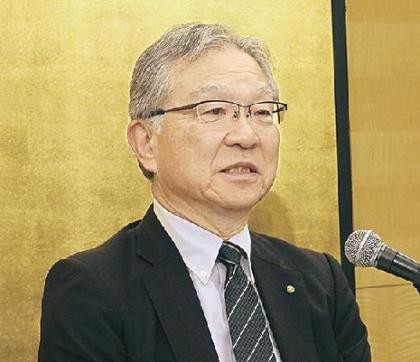
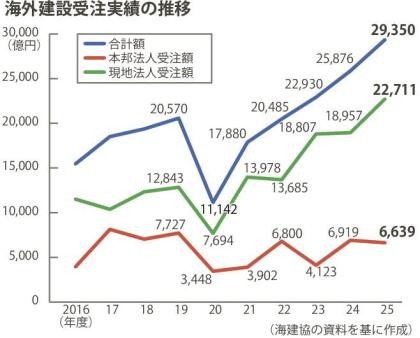
Overseas construction orders secured by the 52 member companies of the Overseas Construction Association of Japan, Inc. (OCAJI) in fiscal 2025 rose 13.4% year-on-year to ¥2,934,959 million, marking a record high for the third consecutive year. The growth was driven by a succession of mega-orders valued at ¥100 billion or more, particularly in Asia. With the domestic construction market expected to contract over the medium to long term, OCAJI analyzes that member companies will continue to focus heavily on international business and anticipates further growth in orders for fiscal 2026.Chairman of OCAJI Masato Sasaki reported the findings at a press conference on June 5. Broken down by region, Asia—the largest market—showed a substantial increase of 19.7% to ¥1,714,690 million. North America, another core market, dipped slightly by 2.0% to ¥898,230 million but sustained a high overall level. By country, the United States retained its top position from the previous year despite a 1.5% decline to ¥876.2 billion, followed by Singapore, which surged 49.3% to ¥734.8 billion.In terms of client categories, orders from public self-funded entities rose 8.3% to ¥1,323.5 billion, local private enterprises increased 27.9% to ¥1,073.3 billion, and Japanese private enterprises abroad grew 16.5% to ¥370.1 billion. In contrast, Official Development Assistance (ODA), which combines yen loans and grant aid, fell 19.1% to ¥168.1 billion.By facility type, building construction dominated the top rankings. Public utility facilities such as hospitals led with ¥750.5 billion (a 106.4% surge year-on-year), followed by commercial buildings at ¥373.9 billion (up 51.6%), factories at ¥348.0 billion (down 22.3%), and residential housing at ¥302.9 billion (up 177.4%).Chairman Sasaki attributed the overall growth to a distinct trend where "overseas construction projects are becoming increasingly massive." Four specific contracts exceeded the ¥100 billion threshold: a hospital, a public facility, and airport civil engineering works in Singapore, alongside a convention facility in the United States.While domestic construction demand in Japan currently remains solid, a long-term decline is projected due to population shrinkage. "Given that markets exist overseas, each company is likely seeking growth in these expanding sectors," Sasaki noted. According to the secretariat, geopolitical tensions in the Middle East have not caused any delays in overseas project schedules. Moving forward, Chairman Sasaki emphasized that OCAJI will continue to support its members by leveraging its information, expertise, and networks with domestic and international institutions, helping companies foster international business growth while appropriately managing risks. (2026/06/09)