

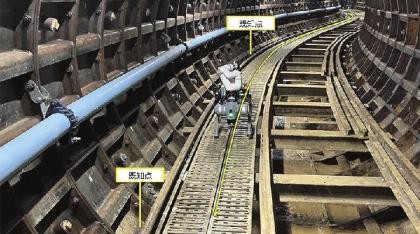
Japanese construction companies Nishimatsu Construction Co., Ltd. and Okumura Corporation have developed a system that leverages quadrupedal walking robots to achieve fully unmanned operations for excavation management surveys in shield tunnel construction. The system integrates an automated charging station—serving as the robot’s launch and standby base—with Nishimatsu Construction’s proprietary remote surveying system. Moving forward, the companies plan to link the system with global navigation satellite systems (GNSS) and other advanced positioning technologies to expand its application beyond tunneling projects.Named "Wan-Wan Surveying", the system utilizes a quadrupedal robot whose movements resemble those of a dog to perform underground surveys for excavation management. The system has undergone validation testing both at an active shield tunnel construction site and within a mock tunnel constructed from actual concrete segments. The trials successfully confirmed that the robot’s autonomous navigation capabilities and surveying precision meet all operational requirements. Patents for the technology are currently pending.The quadrupedal robot used in the system is equipped with a robotic arm, allowing it to navigate flexibly over scaffolding and uneven terrain without being restricted by tunnel alignment or rail infrastructure. It is also outfitted with remote-controlled automated launch and return capabilities. The robot departs autonomously from an automated charging station installed on the trailing gantry and returns to the station to recharge after completing its surveying tasks.Utilizing point cloud data captured via a 3D-LiDAR sensor mounted on its upper chassis, the robot automates the tasks of navigating to reference points and positioning the surveying prism. During this process, the robot deploys its robotic arm while maintaining a stable, low-center-of-gravity posture. By utilizing artificial intelligence in combination with images captured by a camera mounted at the tip of the arm, the system optimizes the arm's positioning to set the prism precisely above the vertical axis of the reference point.Both companies plan to expand the scope of the newly developed system to non-surveying tasks and diverse construction types outside of tunneling. Their long-term vision includes building a platform capable of adapting flexibly to changing site conditions and complex operational environments. For the immediate future, they aim to advance sophisticated "Physical AI" technologies—which fuse sensor technologies with AI—to enhance the robot's autonomous decision-making capabilities and environmental adaptability. (2026/06/15)