

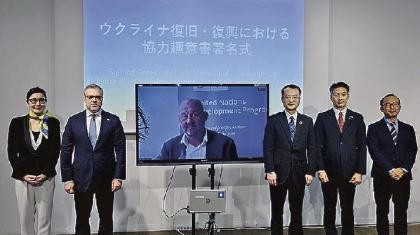
Japan’s Ministry of Land, Infrastructure, Transport and Tourism (MLIT) and the United Nations Development Programme (UNDP) are deepening their partnership to rebuild Ukraine’s infrastructure. By leveraging cutting-edge remote-control construction solutions developed by Kobelco Construction Machinery Co., Ltd. and Soliton Systems K.K., the initiative aims to safely clear the massive volumes of debris generated by the military invasion. The project is specifically designed to create a safe working environment for women and wounded veterans, empowering them to actively participate in the nation's recovery. A signing ceremony for the Letter of Intent was held in Tokyo on June 11th。Beginning this October, Kobelco Construction Machinery will deploy its proprietary "K-DIVE" remote-control system to manage debris processing. The operational cockpit is scheduled to be established in Ukraine's capital, Kyiv. Through local operator training and operational validation, the company plans to lay the groundwork for future business expansion, while considering a support framework managed by local distributors.Soliton Systems will provide "Zao," an ultra-low latency video and control transmission device that can be retrofitted onto existing construction machinery. In 2026, the company will conduct demonstration trials at reconstruction sites, utilizing existing LTE networks to remotely operate backhoes. These trials will focus on training local operators, establishing standardized operational procedures, managing safety protocols, and verifying resistance to signal interference. Looking ahead, the initiative aims to cooperate with JDC Corporation and Yachiyo Engineering Co., Ltd. to recycle the cleared debris into reusable materials for reconstruction.Auke Lootsma, UNDP Resident Representative in Ukraine, joined the ceremony online and expressed deep gratitude for Japan's contributions:"Approximately 60% of the debris removal and sorting resulting from the war has been achieved through Japanese assistance. Japan's advanced remote-control and debris-clearance technologies bring hope and will substantially sustain Ukraine's long-term reconstruction efforts."Kenichi Kawamura, Deputy Minister for International Projects of the Minister's Secretariat at MLIT, emphasized the strategic importance of the collaboration:"We are leveraging Japan’s remote construction technologies to address challenges such as the surging demand for infrastructure rehabilitation and severe labor shortages. Moving forward, the public and private sectors will continue to collaborate closely, utilizing Japanese technology and expertise to contribute significantly to Ukraine's recovery."Yurii Lutvynov, Ambassador Extraordinary and Plenipotentiary of Ukraine to Japan, attended as a guest of honor and underscored the social impact of the technology:"Remote-control technology is vital as it supports the social reintegration of our veterans. I am confident that the cooperation between Ukraine and Japan will yield concrete results on the ground and contribute immensely to rebuilding a more resilient and secure Ukraine." (2026/06/15)