

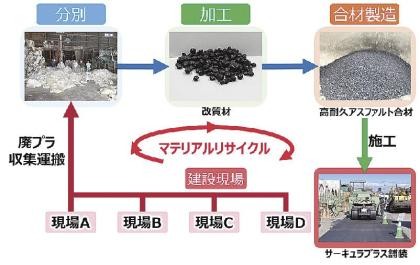
Kajima Corporation and Kajima Road Co., Ltd., announced on July 31 that they have developed a resource-circulating, high-durability asphalt pavement utilizing recycled waste plastics generated directly from construction sites. By replacing a portion of the conventional additive agents blended into asphalt with waste plastics, the newly developed technology significantly enhances pavement durability and extends the required replacement intervals. The initiative establishes a closed-loop material recycling framework within the Kajima Group while contributing to the realization of a circular economy.The technology builds upon Kajima Road’s proprietary method of blending plastic-based modifiers into asphalt mixture to substantially improve durability. Under the new approach, a fraction of the raw plastic modifier is substituted with post-industrial plastic waste collected from Kajima’s active building and civil engineering sites, which is then blended at Kajima Road’s asphalt mixture plants.The finished high-durability asphalt product will be deployed as “Circula Plus Pavement” across construction sites operated by both Kajima and Kajima Road. Supported by intermediate waste processing firms with which Kajima has established recycling partnerships, the group aims to fully realize intra-group material recycling.A trial paving demonstration was conducted within the grounds of Kajima Road’s Technical Development Center in Kuki City, Saitama Prefecture, utilizing a Circula Plus Pavement mixture containing approximately 50% site-derived waste plastics in its modifier compound. Performance evaluations verified rutting resistance through dynamic stability measurements and assessed the operational impact of variability in raw construction plastic waste. The test confirmed that the newly developed pavement offers significantly superior durability compared to standard asphalt paving.By extending the operational lifecycle between pavement maintenance and total reconstruction, the technology reduces the required frequency of resurfacing works. Consequently, the company anticipates not only a substantial reduction in greenhouse gas emissions but also significant life-cycle cost savings, including total long-term maintenance expenses. (2026/08/03)