

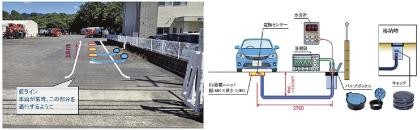
Japanese road construction company Seikitokyu Kogyo Co., Ltd. and the Shibaura Institute of Technology have co-developed a wireless power transfer unit capable of charging electric vehicles (EVs) while in motion directly from the road surface. The project focuses on an exposed installation approach, which promises higher power transfer efficiency than conventional methods that embed charging units deep within pavement layers. Through this joint research, the team has installed the power transfer unit to evaluate the feasibility of continuous, long-distance EV operation. Moving forward, the partners intend to address challenges related to durability and cost to accelerate the practical deployment of wireless charging technology.As part of their joint research, the team developed a full-scale power transfer unit for demonstration testing. The trial successfully highlighted key technical challenges, including optimal wiring methodologies to connect the unit with power supply infrastructure, as well as the verification of waterproofing and water-blocking performance.Future initiatives will focus on design optimization to enhance both the electrical and mechanical performance of the wireless power transfer unit. The partners also plan to construct a comprehensive demonstration system to evaluate overall operational performance. Data gathered across a series of engineering processes—ranging from the excavation of existing pavement and the installation of structures housing the unit to subsequent backfilling and road restoration—will be leveraged to optimize ancillary infrastructure.While dominant frameworks for dynamic wireless charging typically involve embedding units deep within the pavement structure, this method poses significant concerns, such as reduced power transfer efficiency to EVs and the potential for cracking in the surface asphalt mixture. To mitigate these risks, the joint project explored an alternative method where the power transfer unit is exposed at the road surface. In addition to boosting power transfer efficiency, this technique is anticipated to yield substantial structural and economic benefits, including reduced excavation volume, shortened construction timelines, and minimized long-term maintenance costs. (2026/06/16)